This page contains affiliate links. If you purchase through them we may earn a small commission at no extra cost to you. Learn more
Solar Panels on New Build Homes: What Buyers Need to Know
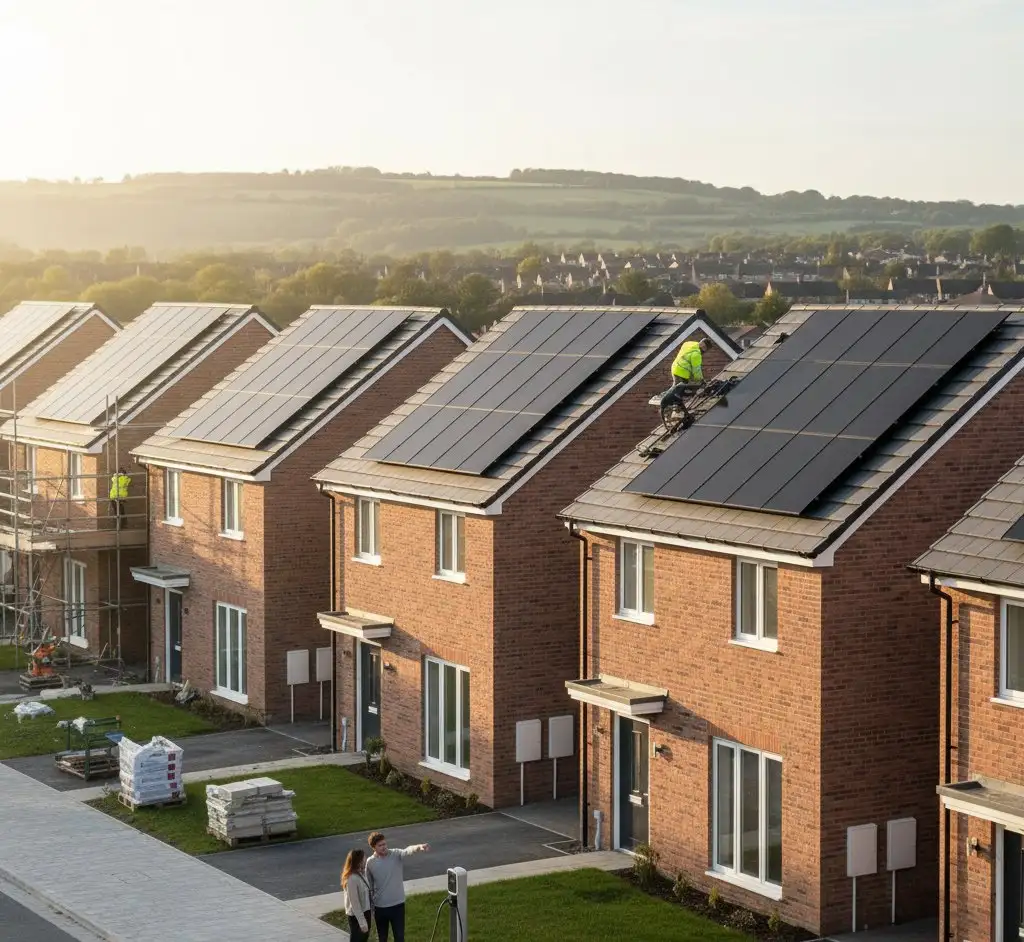
New build homes in the UK increasingly come with solar panels as standard — not because developers are solar enthusiasts, but because building regulations require it. The systems installed are often minimal. Understanding what you've got, what it's worth, and how to improve it is essential for new build buyers.
Why New Builds Have Solar
The short answer: building regulations.
The 2021 Future Homes Standard and the updated Part L of the Building Regulations (effective June 2022) require all new homes to produce 75–80% less CO2 than homes built to the previous standard. Solar PV is one of the most effective ways developers can achieve this.
The SAP (Standard Assessment Procedure) calculation underpins this. SAP is the government's method for rating a home's energy performance. Developers must hit a target SAP score (the Target Emissions Rate, or TER), and solar PV improves the SAP score significantly.
The practical result: many new builds now arrive with a 2–3 kWp solar system as standard, regardless of whether the developer or buyer particularly wants one.
What Developers Actually Install
Developer-installed solar systems are sized for regulation compliance, not for maximum homeowner benefit. Typical characteristics:
- 2–3 kWp capacity — enough to meaningfully improve SAP scores, but small compared to an optimal residential system (4–6 kWp)
- Budget-range panels — tier 2 or tier 3 panels from less-known manufacturers, chosen on price
- Basic string inverter — usually a low-cost single-phase inverter with no battery management capability
- No battery provision — battery storage is rarely included in standard new build packages
- Minimal monitoring — basic generation monitoring, often without consumption data
This isn't necessarily a problem — a 2 kWp system still generates useful electricity. But it's worth knowing that what's installed is often the minimum viable system for compliance purposes, not an optimised setup.
Ask for the MCS Certificate Before Completion
Any solar installation in the UK should come with a MCS (Microgeneration Certification Scheme) certificate. This document confirms the system was installed by an accredited installer to required standards. It's also required to claim payments under the Smart Export Guarantee (SEG). Ask your developer or solicitor to provide this before completion — you'll need it.
SAP Calculations and What They Mean for You
The SAP calculation determines your home's EPC (Energy Performance Certificate) rating and its compliance with Part L. Solar PV feeds into the SAP calculation in several ways:
- It reduces the predicted annual CO2 output of the home
- It reduces the predicted energy cost
- It improves the EPC rating (often pushing a home from B to A)
A higher EPC rating is meaningful beyond compliance:
- Green mortgage products: Some lenders offer preferential rates for A or B rated properties
- Lower running costs: Higher-rated homes cost less to heat and power
- Resale value: EPC A rated homes command a modest premium in most markets
The SAP score assumes a certain generation profile from the panels — if you subsequently upgrade the system, the actual performance will be better than the rated EPC suggests.
Ownership and Warranties on Developer-Installed Solar
Once you complete on the property, the solar system is yours. This includes:
- Panels: Typically carry a 10-year product warranty and a 25-year performance warranty from the manufacturer
- Inverter: Typically 5–10 years warranty, depending on brand
- Workmanship: The installing company provides a workmanship warranty — MCS minimum is 2 years, though quality installers offer 5–10 years. Developer-specified installs may only provide the 2-year minimum.
Critical action: Ask your solicitor to obtain documentary confirmation that all warranties transfer to you on completion. Warranties on developer-installed systems should be assignable to the new owner, but this needs to be explicitly confirmed.
Also check:
- Which company installed the system (MCS certificate will show this)
- Whether the installer is still trading — warranty claims require the original installer or their insurer
- Whether the developer has any ongoing obligations for the system
Developer Warranties Are Only as Good as the Developer
If the solar was installed by a subcontractor under the developer's warranty, and the developer goes into administration (not uncommon in UK housebuilding), your warranty claim may be against a company that no longer exists. Ask specifically about warranty-backed insurance products (such as HIES Consumer Code protection or similar) that survive developer insolvency.
The Inverter Question: What's Installed?
Before thinking about adding a battery, find out what inverter is in your new build. This determines your battery options.
If it's a string inverter (most common in developer installs): You can add a battery via AC coupling — the most practical route without replacing the inverter. See our AC vs DC coupling guide.
If it's a hybrid inverter: You can add a DC-coupled battery directly. Check which battery models are compatible with your specific inverter.
If it's microinverters (less common but some developers use Enphase): AC coupling is your only battery option. Enphase IQ Battery is the natural partner.
Common developer-installed inverters include Solis, Growatt, and Sofar — all string inverters. Battery can be added via AC coupling with no changes to the existing system.
Upgrading a New Build Solar System
Upgrading developer-installed solar is entirely normal and often worthwhile.
Adding More Panels
If your developer installed 2 kWp and your roof has space for 4 kWp, you can add panels. Things to check:
- Inverter capacity: The existing string inverter may not support additional panels without replacement or adding an additional inverter
- DNO limits: Most single-phase connections are limited to 3.68 kW export. Check if additional panels would push you over
- Roof space: New build roofs are often designed with solar in mind — there may be available south-facing space beyond what the developer used
Adding 2–3 panels to an existing 6-panel system is relatively straightforward. A larger addition may require inverter upgrade.
Adding Battery Storage
This is the most common upgrade for new build solar owners. A 2–3 kWp system generates significant electricity during the day — a battery lets you capture it for evening use rather than exporting it at 3–5p/kWh.
For a 2.5 kWp system generating around 2,100 kWh/year:
- Without battery: much of this is exported at SEG rate (3.3–5.2p/kWh)
- With a 5 kWh battery: significant proportion can be self-consumed at 24.67p/kWh value
A 5 kWh battery GivEnergy entered administration in April 2026 — see the resolution tracker for current status. installed typically costs £3,000–5,000.
Replacing the Inverter with a Hybrid
If the developer-installed inverter is approaching end of warranty or you want DC-coupled battery options, replacing it with a hybrid inverter is an option. This is more disruptive and costs £1,200–2,000 for the hybrid inverter plus installation, but future-proofs the system.
This makes most sense if the original inverter is already failing or out of warranty.
What to Check When Buying a New Build With Solar
Before exchanging contracts:
- Request the MCS certificate — confirms the system is properly registered
- Ask for inverter brand and model — check the warranty period and battery compatibility
- Ask for panel brand and model — check performance warranty (should be 25 years)
- Check the SEG eligibility — is the system registered with an SEG supplier, or do you need to set this up?
- Get warranty assignment in writing — panel, inverter, and workmanship warranties should all transfer
- Check the generation meter reading — note the reading at completion so you can track production from day one
For the SEG (Smart Export Guarantee), you'll need to set up an export contract with an energy supplier. The MCS certificate is required to apply. Current rates range from 3.3p/kWh (basic tariff) up to 5.2p/kWh depending on the supplier and tariff you choose.
Claiming SEG From Day One
New build buyers often miss out on months of SEG payments because they don't realise they need to apply. Apply to your chosen SEG supplier (Octopus Energy, Ovo, Solarplicity, and others offer this) as soon as you move in. You'll need your MCS certificate and meter details. SEG payments are retroactive from your application date — not from when the system was installed — so apply promptly.
Panel Quality
Not all panels are created equal, and some developers use budget panels to keep costs down. Before exchanging, check:
- Manufacturer reputation — JA Solar, Trina, Canadian Solar, and LONGi are all well-established. If the brand name means nothing to you and nothing comes up online, that's worth questioning.
- Wattage per panel — below 380W per panel is behind the curve for current technology. It's not a dealbreaker but suggests older or lower-grade stock.
- Product warranty — a 25-year product warranty is standard from quality manufacturers. Some budget brands offer 10–12 years. The performance guarantee (degradation limit) should also be 25 years.
Inverter Quality
The inverter is the component most likely to need attention during the system's life, so the brand matters. Solis, SolarEdge, Fox ESS, Growatt, SunSynk and SolaX are all established names with good UK support. GivEnergy was another mainstay. An unbranded or unknown inverter is a red flag — replacement parts and warranty support can become difficult.
Roof Orientation
New build plot layouts are designed around land efficiency, not solar output. Check which direction the solar panels face before you commit:
North-Facing Panels: A Known Builder Tactic
Some housebuilders have installed solar panels on north-facing roof slopes to meet the regulatory requirement on paper while minimising visual impact from the street. North-facing panels in the UK generate around 50–60% less than south-facing panels. If the sales brochure shows solar panels, check which roof slope they're actually on before exchanging.
Wiring for Future Expansion
Ask whether the electrical system is pre-wired for battery storage, an EV charger, and additional solar panels. All three are significantly cheaper to add during construction than to retrofit later — trunking, ducting, and cable runs are all far simpler when walls are open. If the builder hasn't pre-wired for a battery, find out whether it can be added to the specification before build completion.
Negotiating Upgrades Before You Buy
Most national housebuilders offer solar upgrade packages, and there's more flexibility than many buyers realise. Options commonly available include:
- Additional panels — expanding from a 2.5 kWp compliance system to 4 kWp+ (typically £1,500–3,000 during construction)
- Battery storage — a 5–10 kWh battery added during the build (typically £3,000–5,000)
- Hybrid inverter — upgrading the basic string inverter to one that supports DC-coupled battery addition later
- EV charger — often bundled with solar upgrades at a combined package price
Everything on this list is cheaper during construction than retrofitting afterwards. Scaffolding is already up, the roof is accessible, and cable routes can be designed in from the start.
Negotiation tips worth knowing:
- Ask for the upgrade cost to be rolled into the house price — it then becomes part of your mortgage rather than an upfront payment from savings
- In a slower market, builders are often willing to include upgrades at reduced cost or as an incentive to exchange quickly
- Get the full specification of any upgrade in writing before you exchange contracts — "solar upgrade" as a vague commitment is not enforceable

Fox ESS H3 PRO 5kW Hybrid Inverter
£1,0505
10
2
48V
Affiliate link — we may earn a small commission at no extra cost to you
The Part L 2022 Changes: What They Mean Going Forward
The 2022 Part L update tightened energy performance requirements significantly. The next stage — the Future Homes Standard — was confirmed on 27 March 2026 (Planning Portal) to mandate solar panels on new-build homes in England from 2028, alongside tighter fabric and heating standards. New homes built under the Future Homes Standard will have:
- Better insulation and airtightness
- Heat pumps rather than gas boilers in many cases
- Larger solar systems in many developments
- EV charging provision
If you're buying off-plan (not yet built), it's worth asking the developer specifically which standard the home is being built to and what solar capacity is included. The trajectory is toward larger, better-specified systems as regulations tighten — but execution varies by developer.
After Moving In: First Steps
The day you get your keys, your solar system is already generating — but there are a few things worth doing promptly:
- Register for SEG — contact an energy supplier offering the Smart Export Guarantee and register your system. You need your MCS certificate to do this. Payments start from your registration date, not from when the system was installed, so don't leave this for months.
- Request a handover session — ask the builder or installer to walk you through how to read the inverter display and interpret generation data. Most are willing to do this, and it saves a lot of guesswork later.
- Set up the monitoring app — most modern inverters (Solis, Growatt, SunSynk, Fox ESS, GivEnergy, and others) have a free companion app. Setting this up from day one gives you a clean generation history to work from.
- Consider adding a battery — if your system doesn't include storage, a battery is the single most impactful upgrade for maximising self-consumption. Living in the home for a season first helps you understand your actual usage patterns before deciding on size.
Summary for New Build Buyers
- Your new build solar is a regulated feature, not a premium add-on — treat it as a starting point
- Get your MCS certificate and warranty documents before you move in
- Set up a SEG contract immediately to get paid for exports
- Check your inverter model before planning any battery addition
- Consider upgrading panel capacity or adding a battery once you've lived with the system for a year and understand your actual usage patterns
A 2–3 kWp new build system is useful but undersized for most families. Adding 2 kWp of panels and a 5 kWh battery typically turns a compliant-but-modest system into one that genuinely covers a significant portion of your electricity needs.
Share this article

Order your Energy Performance Certificate online — see how solar improves your home's energy rating. Required before selling or renting. All assessors are fully accredited.
Affiliate link — we may earn a small commission at no extra cost to you
Stay informed
Get free solar updates direct to your inbox
Related reading

How Much Do Solar Panels Cost in the UK in 2026?
UK solar panel costs 2026: realistic prices by system size, what is included, and what to push back on in your quote.
What Happens After Solar Installation: The Commissioning, DNO, and SEG Timeline
Panels are on the roof — now what? From commissioning to your first SEG payment, including the DNO notification timeline nobody tells you about.


Switch to Octopus Energy
Get 50 credit when you switch. We get 50 too — win-win.

Prefer 100% renewable, community-owned?
Your Co-op Energy runs on 100% renewable electricity — profits reinvested in community energy projects.
What does this mean for YOUR home?
Design your perfect solar setup in under 3 minutes. Free, no sign-up required.
Build Your Solar System