This page contains affiliate links. If you purchase through them we may earn a small commission at no extra cost to you. Learn more
How to Pay for Solar in the UK: Finance Options Compared
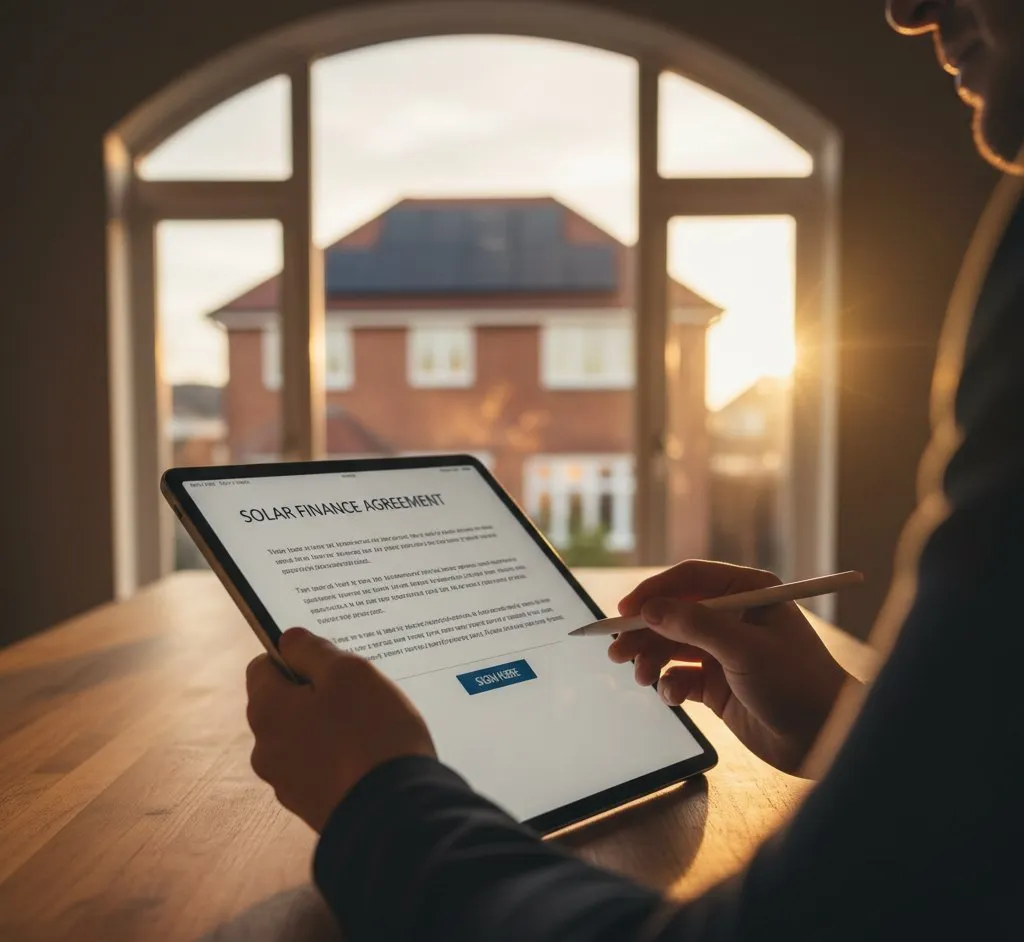
Solar panels are a meaningful upfront investment. Most UK homeowners are looking at £5,000–12,000 for a typical system, and that's before adding battery storage. Understanding your financing options — and the real cost of each — is as important as choosing the right panels and installer.
Check Grants Before You Finance Anything
Before committing to any finance route, it is worth checking whether you qualify for free or subsidised solar through government schemes. ECO4 supports households on certain benefits or with low EPC ratings. Home Upgrade Grant (HUG2) covers off-gas-grid homes. Scottish and Welsh residents have access to additional programmes including the Scottish Government's home energy schemes and the Welsh Government's Warm Homes Programme. These could cover part or all of the cost, making finance unnecessary entirely. See the solar grants guide for full eligibility details.
Option 1: Cash Purchase
Paying cash upfront is the financially optimal approach if you have the funds available.
How it works: You pay the full system cost at point of installation. The system is yours immediately. All savings go directly to you.
The maths: A £7,000 solar and battery system generating £900/year in savings (bill reduction + SEG income) pays back in roughly 8 years. After that, 12–17 years of savings with minimal costs. Over 25 years, total return might be £17,000–22,000 on a £7,000 investment.
Where to compare: No comparison needed — you simply pay the invoice.
Considerations:
- Ties up capital that could earn returns elsewhere (ISA, pension)
- Current ISA rates of 4–5% mean some people are better off investing spare cash and taking a good loan for solar
- For most people without significant savings, cash isn't an option anyway
A cash purchase is almost always the right choice if you have savings earning less than 4% (i.e., in a standard savings account). If your money is in investments earning 7%+, the comparison is more nuanced.
Option 2: Personal Loans (Standard)
A personal loan from a bank or building society is straightforward: you borrow £5,000–12,000 and repay over 3–7 years.
Current rates (April 2026): Major banks and building societies are offering personal loans at 5–8% APR for typical solar loan amounts. Rates vary significantly by credit score.
For a £6,000 loan at 6% over 5 years, you pay £960 in interest. If the solar saves £700/year, you're net positive after year 7 (accounting for the interest cost). Over 25 years, you're still well ahead.
Where to compare: Use comparison sites (MoneySuperMarket, Compare the Market, Uswitch) to check rates across lenders. Don't take the first offer — rate differences of 1–2% make a significant difference over 5–7 years.
Credit Score Matters More Than You Think
Personal loan rates are highly credit-score dependent. The advertised "representative APR" is only offered to 51% of successful applicants. If your credit score is below average, your actual rate may be 3–4% higher than advertised. Check your Experian or Equifax score before applying, and use eligibility checkers (soft searches) to see likely rates without affecting your score.
Option 3: Green Loans and Eco Loans
Several banks and building societies now offer specific "green loans" or "eco loans" at preferential rates for environmental improvements including solar panels.
Current lenders offering green finance (April 2026):
- NatWest Green Loan: Available to existing customers for energy efficiency purposes; often 1–2 percentage points cheaper than their standard personal loan rate
- Nationwide Greener Homes Loan: For members, with competitive rates on qualifying energy-efficiency improvements
- Barclays Greener Home Reward: Cashback and preferential rates on energy-efficient home improvements
- Ecology Building Society: Specialist green lender, good for unusual properties
- Local authority green loans: Some councils offer interest-free or low-interest loans for solar and insulation — check your council's website
Green loans typically run at 3–5% APR — genuinely better than standard personal loan rates. They often require proof that the funds are spent on qualifying improvements (invoices, MCS certificates).
Are green loans actually better?
Yes, genuinely. The rate advantage over a standard personal loan saves real money. A £7,000 loan at 4% vs 7% over 5 years saves roughly £530 in interest. That's meaningful.
The catch: eligibility criteria are stricter, and approval takes longer. Some green loans require an EPC assessment before and after the installation.
Also worth checking: mutual building societies. Coventry, Leeds, Yorkshire, and other mutuals often have competitive home improvement loan products with simpler eligibility criteria than high-street banks. These are unsecured personal loans, but building societies sometimes offer better terms than bank equivalents for the same credit profile.
Option 4: 0% Finance from Installers
Many solar installers offer 0% finance deals — "buy now, pay over 3 years with no interest." These sound excellent. They're worth scrutinising carefully.
How 0% installer finance works:
Installers don't absorb the cost of offering 0% finance themselves. Instead:
- A third-party finance company (often a consumer credit lender) provides the loan
- The installer receives a "merchant fee" subsidy payment from the lender, reducing their margin
- To protect their margin, installers often price the system higher for finance customers than cash customers
The 0% rate is real — but you may be paying more for the system itself.
What to check:
- Get a written quote for the same specification with cash payment. If the installer won't give you a cash price, walk away.
- Compare the finance price to other installer quotes for the same spec.
- Read the finance agreement carefully: what happens if you miss a payment? Does the 0% convert to a high rate?
Some 0% deals are genuinely good — the installer absorbs the merchant fee from their margin. Others involve system prices inflated by 10–15%. Know what you're comparing.
Longer 0% or low-rate finance deals (5–7 years) from installer-partnered finance companies are common. These are typically provided by specialist lenders (Novuna, Hitachi Capital, Ikano) and are regulated consumer credit products. Check whether there is a balloon payment at the end, and what the APR reverts to if you miss a payment.
0% Finance and Cooling-Off Periods
All consumer credit agreements have a 14-day cooling-off period under the Consumer Credit Act. During this period you can withdraw from the finance agreement and cancel the installation (if not yet complete). Never sign a finance agreement on the day of a sales visit — take it home, read it properly, and make sure the system price is competitive before committing.
Option 5: Additional Borrowing on Your Mortgage
If you have significant equity in your home, you may be able to borrow against it for solar installation. This can be done as:
- Further advance from your existing lender: Your mortgage provider lends you additional funds, secured against the property
- Remortgage with additional borrowing: Switch to a new mortgage deal with a larger loan amount
Advantages:
- Mortgage rates are typically lower than personal loan rates (though this depends on your current mortgage deal and the new rate available)
- Repayments are spread over a longer term, reducing monthly costs
Disadvantages:
- You're securing the debt against your home — failure to repay has serious consequences
- Extending a mortgage term means paying more interest overall even at a lower rate
- Early repayment charges on existing mortgages may apply
This approach makes most sense if you have a variable-rate or tracker mortgage with no early repayment charges, and your lender offers a further advance at a rate below 5%.
Green Mortgage Products
Some lenders offer preferential rates on mortgages for properties with high EPC ratings (A or B). Installing solar can improve your EPC rating, potentially unlocking a better mortgage deal on remortgage. Worth checking what your EPC is now and what it would be post-installation — a jump from C to B or B to A can open different product tiers. See our green mortgages guide for which lenders offer what, or Unmortgageable for broader mortgage guidance.
Option 6: Solar PPA (Power Purchase Agreement)
A solar PPA is an arrangement where a third party installs panels on your roof at no upfront cost. You agree to buy the electricity they generate at a set rate (typically below grid rate) for a fixed period — usually 10–25 years.
How it works:
- An investor/company installs, owns, and maintains the solar panels
- You buy the solar electricity at an agreed rate (e.g., 15–18p/kWh)
- This is cheaper than the grid rate (24.67p/kWh) but you don't own the panels or benefit from the full saving
- At the end of the agreement, you may be able to buy the panels or have them removed
Who offers this in the UK?
The PPA market for residential properties in the UK is limited compared to the commercial sector. Some community energy schemes offer residential PPAs; some larger installers are exploring the model. It's not yet mainstream for domestic solar.
Advantages:
- No upfront cost
- Maintenance is the PPA provider's responsibility
- You get cheaper electricity without the capital commitment
Disadvantages:
- You never own the panels — the savings are always shared with the PPA provider
- Long contract terms (10–25 years) create complications if you sell the property
- The PPA may or may not transfer to a new buyer; this can complicate property sales
- Total electricity cost over the contract is often higher than owning outright
A PPA is suitable for people who genuinely cannot access financing and value lower electricity bills over ownership. For anyone who can get a personal loan or green loan, owning the system directly is financially superior.
Option 7: Solar Leases
Solar leases exist in the UK but are far less common than in the US. Under a lease, a company installs panels on your roof and you pay a monthly fee to use the electricity they generate. You never own the panels.
How it works: A third party installs and owns the system. You pay a fixed monthly fee in exchange for the electricity those panels produce. At the end of the lease term — typically 20–25 years — you may be offered the chance to buy the panels or have them removed.
Why leases rarely make sense in 2026:
- Total cost tends to be much higher than buying outright or taking a personal loan — lease payments over 20 years often total £12,000–£18,000 or more on a system that costs £7,000–£9,000 to own
- You don't benefit from SEG export payments — the lease company keeps the export income because they own the panels
- Property complications — leases can be registered against your property title and may complicate or delay a sale, as any buyer needs to take on the lease or the company must agree to terminate it
- Long terms with limited exit options — a 20–25 year commitment is a long time; early exit clauses are often costly
- You lose control — the lease company decides when and how maintenance is carried out, and which equipment to use for replacements
Solar leases made more sense when panels cost £15,000+ and the Feed-in Tariff was generous. With panel costs dramatically lower today, leasing rarely stacks up for homeowners.
Option 8: Rent-a-Roof (Free Solar) Schemes
Under rent-a-roof arrangements, a company installs panels on your roof at no upfront cost. They own the panels, keep all the export income, and in return you receive free electricity during the hours the panels are generating.
What you get: Free daytime electricity from the panels — which is genuinely useful if you are at home during the day and can shift appliance use to match generation.
What you give away:
- The SEG export income (potentially £200–£400/year depending on system size and export behaviour) — goes to the company, not you
- A 20–25 year interest in your roof, which the company registers and which complicates any property sale — buyers and their conveyancers will want clarity on the arrangement
- Control over the installation — the company chooses the equipment, decides on maintenance, and determines the terms of any future changes
In 2026, with solar panels far more affordable than when rent-a-roof schemes launched, the maths have shifted significantly against these arrangements. A personal loan to own your own system is almost always the financially superior route — you get the full savings, the full SEG income, and no long-term encumbrance on your property.
Option 9: Buy Now, Pay Later (BNPL)
Some installers are beginning to offer BNPL-style finance through providers like Klarna or dedicated home improvement BNPL platforms. This is worth treating with caution for large solar purchases.
Why BNPL is risky for solar:
- BNPL products for large amounts typically convert to a high-interest loan if not repaid within the promotional period — often 29–39% APR
- Promotional periods are short (3–12 months) — insufficient to generate enough savings to offset the cost
- BNPL regulation for larger amounts is still developing — consumer protections may be weaker than regulated credit agreements
- Missing a payment can trigger the full balance becoming immediately due
For a £7,000 solar system, BNPL makes no sense unless you're certain you can repay within the promotional 0% period. A personal loan or green loan is a far safer approach.
Credit Cards: When They Help and When They Don't
Standard credit card APRs run 22–29%. A £7,000 solar purchase on a credit card that you pay off over 3 years costs roughly £3,500–4,500 in interest — more than doubling the effective cost and eliminating most of the financial benefit of solar.
That said, there is one limited scenario where a credit card can be useful: using a 0% purchase card to cover a deposit or partial payment. Cards with promotional periods of 18 months or longer give you time to clear a smaller sum interest-free. If you use this approach, be clear on two things: the promotional period end date (after which rates jump to 22–29%), and whether the remaining balance will be paid before that date.
Under Section 75 of the Consumer Credit Act, paying any part of a solar purchase (between £100 and £30,000) by credit card gives you additional protection — your card provider is jointly liable with the installer if something goes wrong. This can be a useful backstop if the installer fails to complete the work or the equipment is faulty. But this benefit does not make a credit card an appropriate primary funding method for a large installation.
Honest Comparison: Total Cost Over 10 Years
For a £7,000 solar and battery system saving £900/year:
*Mortgage is spread over 25 years; monthly cost is low but total interest is high **PPA saves less per year as you share savings with provider — roughly £420/year instead of £900/year
What to Avoid
- Credit cards — high APR destroys the economics
- BNPL for amounts you can't repay quickly — promotional periods end, rates become punishing
- Signing a finance agreement on the day — always take it home and compare
- Assuming 0% means cheapest — check the system price independently
- Extending a mortgage term unnecessarily — lower monthly payments can mean far more total interest
A Practical Path Forward
Priority order for financing
Work through this list in order — each option is better than the ones below it:
- Check grants first — ECO4, HUG2, and devolved schemes are free money. If you qualify, everything else becomes secondary.
- Pay outright if you can — best lifetime return, no interest, no complications.
- Green loan or personal loan — if you need to borrow, this is the right approach for most homeowners. You own the system, you keep all the savings and SEG income.
- Mortgage borrowing — cheapest headline rate, but the long term means more total interest. Worth running the numbers.
- 0% installer finance — only worth considering if you can verify the system price matches what you would pay in cash.
- Avoid leases and rent-a-roof — the economics do not work for most homeowners in 2026. You give away income and create long-term roof complications in exchange for benefits you could access more cheaply through a loan.
Steps to take
- Get 3 installer quotes — understand the cash price of your system
- Check your EPC — a post-installation EPC B or A opens up green mortgage products
- Check green loan rates — your bank, building society, and comparison sites
- Compare standard personal loan rates — using eligibility checkers (soft search only)
- Evaluate any 0% offers against the cash price from the same installer
- Decide — cash if you have it earning below 4%; green loan if available; standard personal loan otherwise
Solar is a 25-year asset. The financing choice you make now affects the economics for years. Taking an extra week to compare options properly is always worth it.
£530
saved in interest by using a 4% green loan vs 7% personal loan on £7,000 over 5 years
Get solar quotesShare this article
Sell your property fast — solar panels can increase your home's value and make it more attractive to buyers
Affiliate link — we may earn a small commission at no extra cost to you
Stay informed
Get free solar updates direct to your inbox
Related reading
How Much Do Solar Panels Cost in the UK in 2026?
UK solar panel costs 2026: realistic prices by system size, what is included, and what to push back on in your quote.
0% VAT on Solar Panels: What Qualifies?
Zero-rate VAT on solar panels saves UK homeowners 20% on installation costs. What qualifies, what doesn't, and how to make sure your quote is correct.


Switch to Octopus Energy
Get 50 credit when you switch. We get 50 too — win-win.

Prefer 100% renewable, community-owned?
Your Co-op Energy runs on 100% renewable electricity — profits reinvested in community energy projects.
What does this mean for YOUR home?
Design your perfect solar setup in under 3 minutes. Free, no sign-up required.
Build Your Solar System