This page contains affiliate links. If you purchase through them we may earn a small commission at no extra cost to you. Learn more
Octopus Go vs Flux: Which Tariff Is Better for Solar and Battery?

Both Octopus Go and Octopus Flux are time-of-use tariffs that reward shifting your electricity use away from peak hours. But they are designed for different households, and picking the wrong one for your setup can cost you hundreds of pounds a year. This article walks through the rate structures, worked savings examples, and the situations where each tariff has the edge.
How each tariff works
Octopus Go
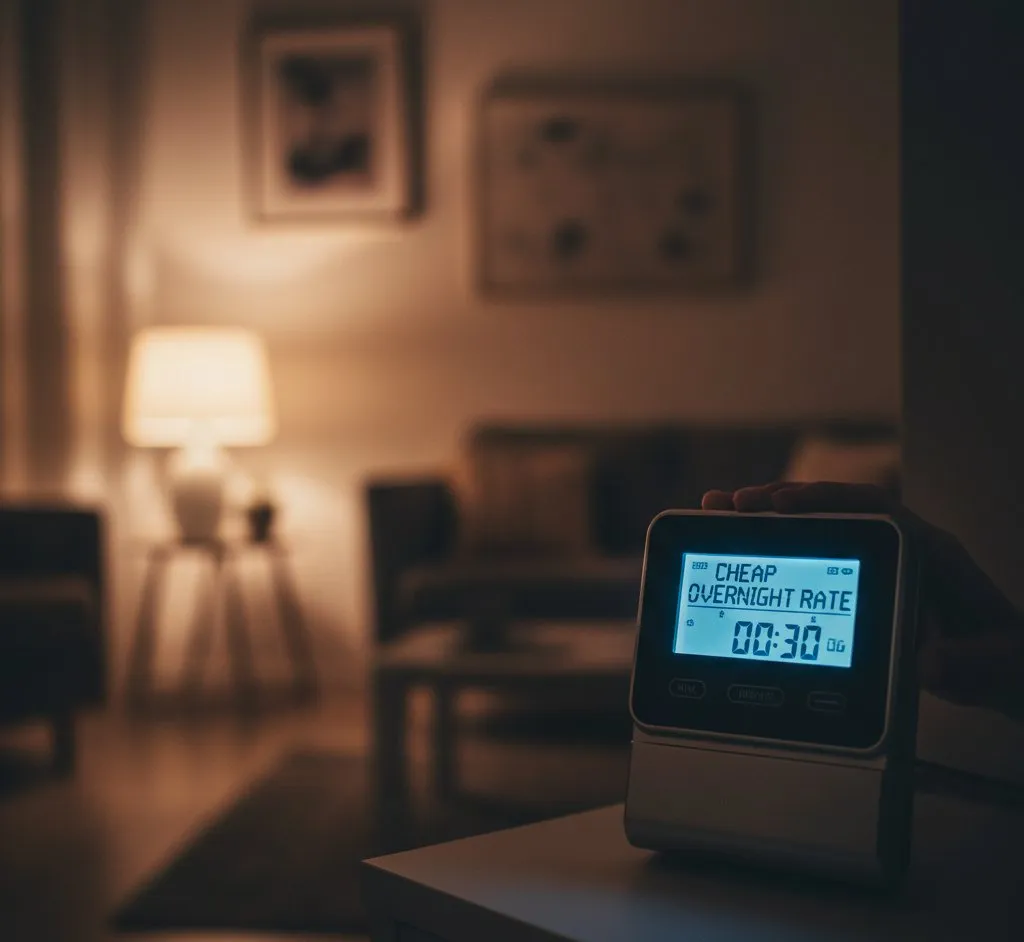
Go is a two-rate tariff built around overnight cheap electricity. The entire day splits into two zones:
- Overnight (00:30–05:30): ~7.5p/kWh — a five-hour window for charging EVs or home batteries
- All other hours: 24.67p/kWh — in line with the standard flat tariff
There is no built-in export rate. If you export surplus solar, you need a separate Smart Export Guarantee (SEG) contract. Basic SEG rates from most suppliers sit between 3.3p and 5.2p/kWh; better fixed SEG deals can reach around 15p/kWh as of April 2026.
Go's strength is simplicity. Five hours of cheap electricity, one rate for everything else. Easy to model, easy to manage.
Octopus Flux
Flux has three rate periods every day, with matching import and export rates for each window:
Rates from verified-rates.json, April 2026. Check Octopus Energy directly for current figures — rates move with the Ofgem price cap.
The peak window is Flux's defining feature. During those three hours, you pay 34p/kWh if importing from the grid — but you earn 24.67p/kWh for every kWh you push back to the grid. A battery that charges overnight at 10p and exports during the peak at 24.67p captures a 14p/kWh spread, before accounting for round-trip efficiency losses.
Flux is suspended as of May 2026 (temporarily unavailable)
Octopus Flux is temporarily suspended as of May 2026. Existing customers are unaffected. Octopus has a track record of reopening tariffs when capacity allows, so it is worth monitoring their website. Do not make hardware purchasing decisions assuming you will be able to join Flux — model your finances on what you can actually sign up for today.
Rate comparison at a glance
Go's overnight rate of ~7.5p/kWh is meaningfully cheaper than Flux's 10p off-peak rate. Flux makes up for that with the built-in 24p peak export payment that Go cannot match.
Worked example: 4kW solar + 10kWh battery
To make the comparison concrete, take a household with a 4kWp solar system and a 10kWh battery. Assume:
- 3,400kWh annual solar generation
- 4,000kWh annual household consumption
- 1,200kWh exported annually (surplus solar after home use and battery charging)
- Battery cycled daily: charge overnight, discharge evening
On Octopus Go
- Overnight battery charge: 8kWh per night (a typical daily cycle), 365 nights = 2,920kWh at ~7.5p = £161
- Day rate imports (what the battery and solar don't cover): ~1,500kWh at 24.67p = £360
- Export income (SEG at 15p): 1,200kWh at 15p = £180 credit
- Estimated net annual cost: £341
On Octopus Flux
- Off-peak battery charge: 8kWh per night at 10p = 2,920kWh = £292
- Day rate imports: ~1,500kWh at 24.67p = £360
- Peak window exposure: with the battery discharged into the peak window, ~3kWh exported per day on 200 sunny days = 600kWh at 24.67p = £144 credit; battery also avoids peak import on ~160 winter days, saving ~2kWh × 10p spread × 160 = £32
- Day export income: remaining 600kWh exported at 10p = £60 credit
- Estimated net annual cost: £416
These are illustrative numbers — your results will vary
The calculations above use average daily cycling and a simplistic seasonal split. Your actual saving depends on how much solar you generate, how much of your battery charge you can export during the peak window versus consume at home, and how closely your schedule matches the Flux windows. Use the tariff arbitrage calculator below to model your specific setup.
In this example, Go comes out ahead — primarily because its overnight rate (~7.5p) is 4.5p cheaper than Flux's off-peak rate (10p), and that difference compounds across 2,920kWh of annual battery charging.
Flux catches up and can overtake Go when:
- The household has a larger battery (more kWh to export at 24.67p each evening)
- Evening consumption is low, leaving more battery charge available for peak export
- Solar generation is strong enough to fill the battery from the sun, reducing dependence on overnight grid charging
When Go has the edge
Go tends to win for:
- EV owners who want cheap overnight charging without the complexity of a three-rate system
- Battery-only homes (no solar) where there is no peak export to earn from Flux
- Solar homes with heavy evening consumption — if your household uses most of the battery charge for cooking, heating, and appliances between 16:00 and 22:00, there is little charge left to export at the Flux peak rate
- Households on a budget — Go's ~7.5p overnight rate is the cheapest fixed overnight rate available from Octopus as of April 2026, and that low charging cost has immediate, predictable value
When Flux has the edge
Flux tends to win for:
- Solar-and-battery homes with automated scheduling — if your inverter or home energy system can automatically charge from 02:00–05:00 and export from 16:00–19:00, the three-rate structure captures its full potential without manual intervention
- Homes with large batteries — a 15kWh or 20kWh battery has more capacity to export during the peak window after covering home use, increasing the value of the 24p export rate
- Low evening consumption households — if you use less electricity in the evening (out, away, or already covered by solar), your battery arrives at 16:00 fuller and exports more at the premium rate
- High afternoon usage — paradoxically, households that would otherwise buy electricity at 34p/kWh during the peak window gain most from avoiding that rate, even before counting export income
Can you switch between them?
Yes. Octopus does not charge exit fees on any of their tariffs. If you are on Go and Flux reopens to new customers, you can apply to switch. Switching takes a few weeks for metering and account setup to complete. It is worth modelling both tariffs with your actual consumption data before switching — your Octopus account shows half-hourly consumption which makes this reasonably straightforward.
Check the Octopus tariff comparison tool
Octopus Energy has a comparison tool on their website that lets existing customers model different tariffs against their actual usage. If you are already an Octopus customer, this is a more reliable way to estimate switching value than a generic worked example.
What about Agile?
If you are comparing Go and Flux, it is worth knowing that Octopus Agile exists as a third option. Agile has half-hourly variable pricing that tracks the wholesale electricity market. On the best days, overnight rates can fall below 5p/kWh — sometimes going negative, meaning you are paid to consume. On bad days, rates can spike above 30p/kWh.
For solar-and-battery homes with automation (Home Assistant via local Modbus, SunSynk Connect, Tesla Energy Plan, or similar), Agile can outperform both Go and Flux in a good year. GivEnergy entered administration in April 2026 — see the resolution tracker for current status. The trade-off is volatility and the time investment in monitoring or configuring automated responses to price signals. Agile also has a companion export tariff (Agile Outgoing) that can pay 8–12p/kWh on average, with occasional spikes much higher.
If predictability matters to you, Go or Flux will suit you better than Agile. If you enjoy optimising and have the right automation in place, Agile is worth exploring as an alternative or future upgrade.
Summary
Octopus Go offers the cheapest fixed overnight import rate (~7.5p/kWh) and suits any home that wants to charge a battery or EV cheaply overnight. It is simple, accessible, and currently open to new customers.
Octopus Flux offers a more sophisticated three-rate structure with a compelling 24.67p/kWh peak export rate that can generate meaningful export income for well-optimised solar-and-battery homes. Its off-peak import rate (10p/kWh) is higher than Go's, so the maths only favours Flux when you have enough battery capacity and solar generation to export meaningfully during the peak window.
Before committing to either tariff, model your specific numbers using your actual consumption data. The rate structures are public and the arithmetic is not complicated — the answer depends almost entirely on your battery size, solar output, and how much electricity you consume during the evening peak hours.
Tariff arbitrage calculator
Charge your battery at off-peak rates, use it during expensive peak hours. Pick a tariff to auto-fill the rates.
5 hour overnight window (00:30–05:30), standard daytime rate
10 kWh
10 kWh/day
24-hour rate — off-peak window 00:00 to 05:00 (5h)
Daily saving
£1.46
Annual saving
£533
Usable capacity
9 kWh
Actually displaced
7.9 kWh
limited by peak-hour usage
Your 10 kWh/day usage is spread across 24 hours. Roughly 7.9 kWh of it falls in the 19-hour peak window (everything outside the 5-hour off-peak window). The battery can only save you money on the peak-hour portion — the rest is already being imported during the cheap window, so there is nothing to arbitrage. This is why a 32 kWh battery with 30 kWh of daily usage shows 7.9 kWh displaced: you are only using 7.9 kWh during expensive hours in the first place. 90% usable capacity accounts for battery health reserve.
Share this article
Stay informed
Get free solar updates direct to your inbox
Related reading
Octopus Go and Intelligent Go Explained
How Octopus Go and Intelligent Octopus Go work for UK households with EVs and solar panels — rates, eligibility, and real-world savings in 2026.

Octopus Flux Tariff: The Best Tariff for Solar + Battery?
How Octopus Flux works for UK solar and battery owners — import/export rates, daily schedule, real savings calculations, and whether it beats Agile.


Switch to Octopus Energy
Get 50 credit when you switch. We get 50 too — win-win.

Prefer 100% renewable, community-owned?
Your Co-op Energy runs on 100% renewable electricity — profits reinvested in community energy projects.
What does this mean for YOUR home?
Design your perfect solar setup in under 3 minutes. Free, no sign-up required.
Build Your Solar System